



Salesforce is one of the most powerful CRM platforms in the world. For financial services firms — wealth management companies, family offices, investment firms — it handles the heavy lifting: client data, compliance tracking, reporting, pipeline management. It’s the backbone of the operation.
But here’s the problem almost every firm runs into eventually: Salesforce was designed to be an incredible internal tool. It was never designed to be the experience your clients interact with.
The Gap Between Backend Power and Frontend Experience
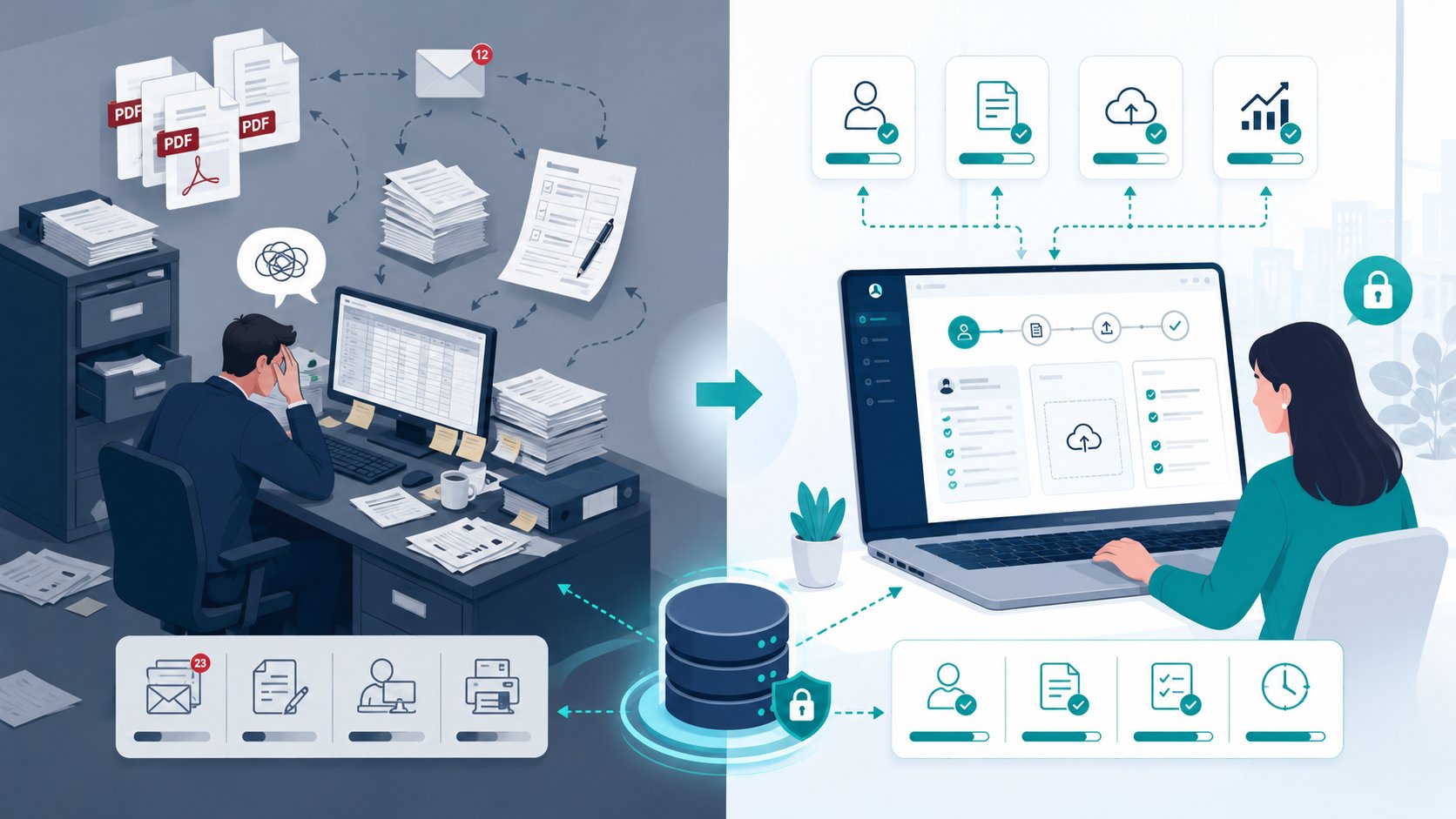
Walk into any wealth management firm and ask the operations team how investor onboarding works. The answer is almost always the same: PDF forms sent via email, data manually re-entered into Salesforce by staff, documents collected through back-and-forth email chains, and performance reports exported as static attachments.
Salesforce holds all the data. But the client never touches Salesforce. The client experiences email, PDFs, and waiting.
This creates three cascading problems:
The client experience doesn’t match the quality of the firm’s work. Your investment strategy might be exceptional, your advisory team brilliant — but if the onboarding process feels like filling out a car insurance form from 2005, that’s the impression that sticks. In an era where every fintech startup offers sleek, instant digital experiences, a PDF-and-email workflow signals that you haven’t invested in the details.
Your operations team burns hours on data entry. Every form that arrives via email needs to be manually entered into Salesforce. Every document needs to be filed. Every status update needs to be communicated by a person. This isn’t skilled work — it’s transcription. Your best people are spending their time copying data between systems instead of serving clients.
You have zero visibility into where things stand. When a client asks “where is my onboarding?” the answer requires someone to check Salesforce, check email, check the document folder, and piece together a status update. There’s no single dashboard, no progress tracker, no real-time view of the pipeline.
 What Clients Actually Need
Your clients don’t need access to Salesforce. They need a modern, secure, branded experience that connects to Salesforce on the backend while presenting a completely different interface on the frontend.
Think about what a best-in-class client experience looks like for a wealth management firm:
A secure client portal where investors log in, see their accounts, review performance data, and access documents — all pulling live from your Salesforce instance. A guided onboarding workflow that walks new clients through every required form, collects documents through a secure upload (not email), validates information in real time, and syncs directly to Salesforce without anyone re-keying data. A mobile app that gives clients access to their portfolio and communications from their phone.
None of this replaces Salesforce. It extends it. Salesforce remains the system of record, the compliance backbone, the single source of truth. But the client-facing layer becomes something modern, intuitive, and worthy of the firm behind it.
Why Off-the-Shelf Portals Fall Short
The natural instinct is to search for an existing product — a Salesforce portal plugin, a pre-built investor dashboard, an off-the-shelf onboarding tool. There are dozens of these on the market.
The problem is that every financial services firm operates differently. Your compliance requirements are unique. Your onboarding forms are specific to your business. Your client segmentation (individuals, trusts, entities, joint accounts) requires custom logic. Your integration needs extend beyond Salesforce to platforms like eMoney, Addepar, Black Diamond, or Orion.
Off-the-shelf tools give you 70% of what you need and force you to adapt your business to fit the remaining 30%. For a firm where compliance, security, and client trust are non-negotiable, that 30% gap is where the risk lives.
The Custom-Built Alternative
A custom portal built specifically for your firm solves this completely. It connects to your Salesforce instance through secure APIs, reflects your exact workflows, handles your specific entity types and compliance requirements, and presents your brand — not a third-party vendor’s brand — to your clients.
The build-versus-buy math often surprises firms: a custom portal costs less than you think when compared to the ongoing licensing fees, customization costs, and workarounds required to make an off-the-shelf tool do what you actually need. And unlike a SaaS product, you own it. No vendor lock-in, no surprise price increases, no feature deprecation.
What This Looks Like in Practice
We recently built exactly this for a wealth management firm in South Florida. They were running Salesforce for all backend operations but onboarding new investors through email and PDF forms. We built a secure investor portal integrated directly with their Salesforce instance — automated onboarding, live performance dashboards, and a secure document vault. Their operations team recovered over 15 hours per week previously spent on manual data entry. The entire build took four months from kickoff to launch with zero changes to their existing Salesforce setup.
The key insight: they didn’t have to choose between Salesforce and a modern client experience. They got both.

Is Your Firm Ready?
If your firm runs on Salesforce but your clients still experience PDFs and email chains, the gap is only going to widen. Every month you wait, client expectations continue to rise — and competitors who invest in their frontend will start winning the clients who care about experience as much as performance.
The good news: you don’t have to replace anything. You just need to build the modern layer on top of what already works.
Learn how Simple Solutions builds client portals for financial services firms →