



At some point, every growing financial services firm faces the same decision: do we buy an off-the-shelf portal product, or do we build something custom?
The instinct is usually to buy. It feels faster, cheaper, and lower-risk. Someone else has already solved this problem, right? Just plug it in and go.
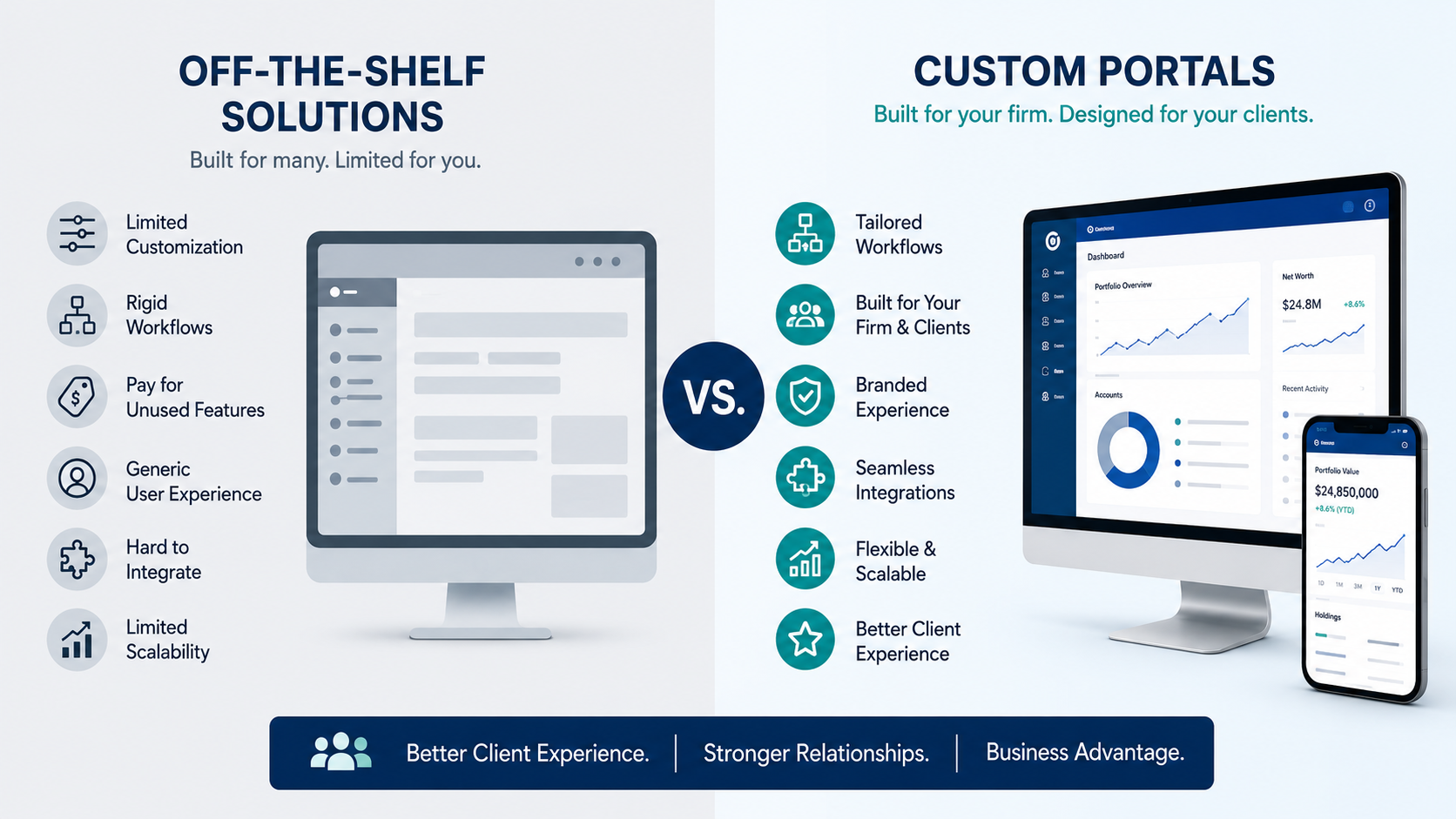
But for wealth management firms, family offices, and investment companies, the buy path almost always leads to the same place: a product that does 70% of what you need, costs more than you expected to customize, and still doesn’t quite fit how your firm actually operates.
Here’s why custom-built portals consistently outperform off-the-shelf solutions for financial services — and why the math isn’t as one-sided as it first appears.
The 70% Problem
Off-the-shelf portal products are built for the average firm. They handle the common use cases well: basic client login, document storage, maybe some reporting. If your firm operates exactly like the product was designed for, it works.
The problem is that no financial services firm operates like the average. Your onboarding forms are specific to your compliance requirements. Your client segmentation — individuals, trusts, entities, joint accounts, family groups — has rules that are unique to how your firm structures relationships. Your integration needs go beyond a single CRM to include financial planning tools like eMoney, portfolio analytics platforms like Addepar, and custodial data feeds.
That remaining 30% — the part the product doesn’t handle — is where you end up spending the most time and money. You hire consultants to customize the platform. You build workarounds. You ask your team to adapt their processes to fit the software instead of the other way around. And you pay ongoing licensing fees the entire time.
 The Hidden Costs of Buying
When firms evaluate off-the-shelf solutions, they typically look at the monthly or annual license fee and compare it to the cost of a custom build. On paper, the license fee looks cheaper. But that calculation misses several significant costs that only become apparent after implementation:
Customization fees. Most portal products charge for customization — and financial services customization is never simple. Compliance-specific workflows, custom entity types, bespoke reporting formats, and API integrations with your specific technology stack all require professional services hours billed at the vendor’s rates, which are often higher than what a custom development partner would charge.
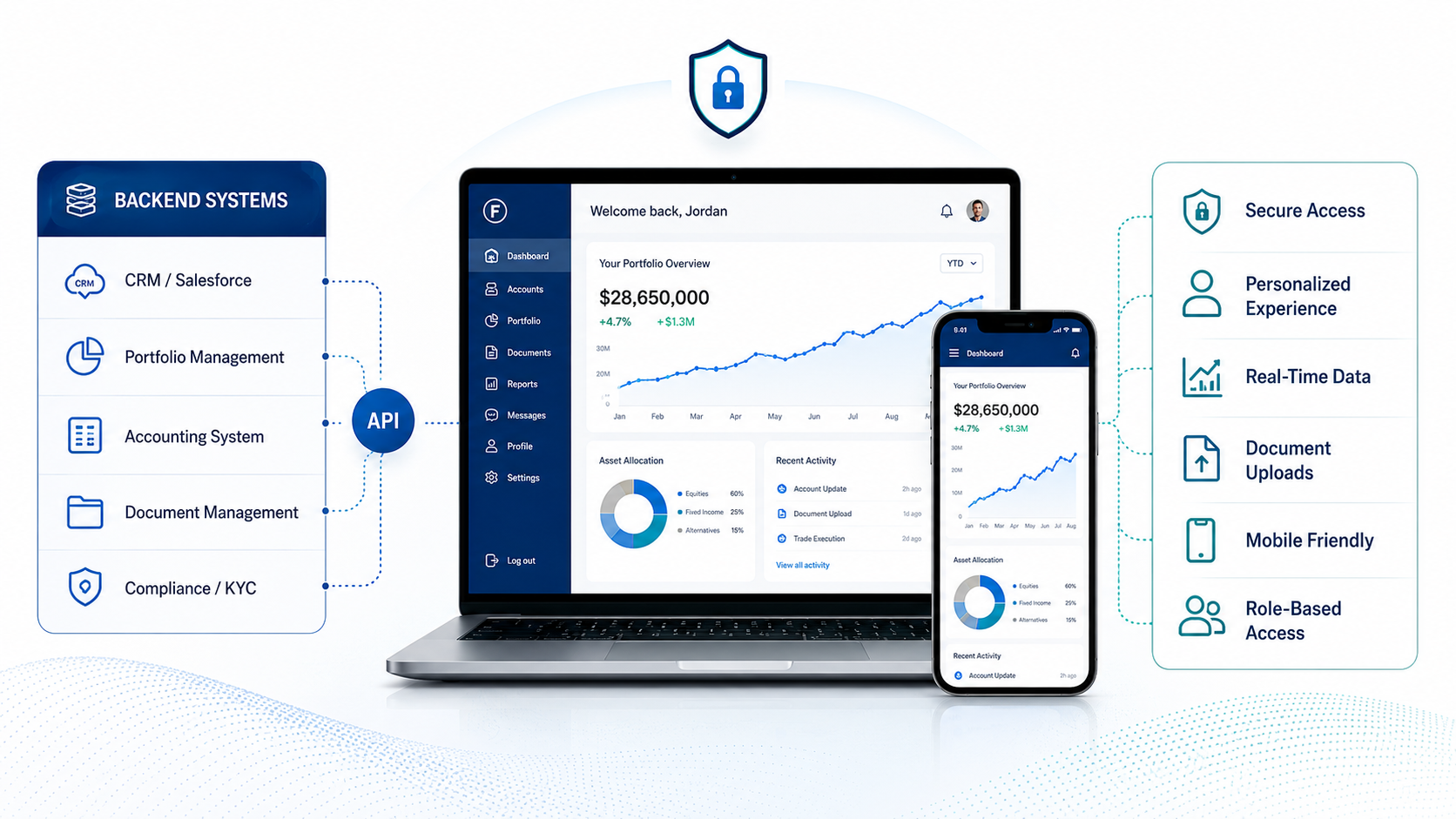
Integration limitations. Off-the-shelf products have pre-built integrations with popular platforms, but financial services firms rarely use a standard stack. If your combination of Salesforce, eMoney, Addepar, and a custodial data feed doesn’t match the vendor’s integration library, you’re either paying for custom connectors or building middleware to bridge the gaps.
Vendor lock-in. Once your client data, documents, and workflows live inside a vendor’s platform, switching costs become enormous. This gives the vendor leverage to raise prices, deprecate features, or change terms — and you have limited recourse. A custom-built portal is owned by you, hosted on your infrastructure, and portable.
Ongoing licensing fees that never stop. A custom build has a one-time development cost and then modest ongoing maintenance. An off-the-shelf product charges you every month, forever. Over a 3–5 year horizon, the total cost of ownership often favors custom development — especially when you factor in the customization and integration fees on top of the license.
What Custom Gets You That Off-the-Shelf Can’t
Beyond cost, there are things a custom-built portal delivers that no off-the-shelf product can match:
Your brand, your experience. A custom portal is built in your visual identity, with your terminology, your workflow language, and your client communication style. It feels like an extension of your firm — because it is. Off-the-shelf products, no matter how much you customize the CSS, always feel like someone else’s platform with your logo on it.
Exact-fit workflows. If your firm requires seven-step onboarding for trusts but four steps for individuals, with different document requirements and different approval chains, a custom build handles that natively. You design the workflow; the software follows. With off-the-shelf, you design the workflow and then figure out which parts the software can accommodate.
Deep integration. A custom portal can connect to any system with an API — Salesforce, NetSuite, eMoney, Addepar, Black Diamond, custodial feeds, banking APIs, compliance databases. The integration is designed from the ground up to work with your specific data model, not a generic one.
Ownership and control. You own the code, the data architecture, the hosting environment, and the roadmap. No vendor decides to deprecate a feature you depend on. No surprise price increase forces a renegotiation. No acquisition by a larger company changes the product direction overnight.
When Buying Does Make Sense
To be fair, off-the-shelf products are the right choice in certain situations. If your firm is small (under 10 employees), operates with a very standard workflow, has minimal integration needs, and doesn’t expect significant growth or process complexity, a pre-built portal can serve you well at a lower initial cost.
But the moment you start customizing — and in financial services, you almost always do — the equation shifts. The question isn’t whether custom costs more upfront. It’s whether custom costs less over the life of the solution, while delivering a better experience for your clients and your team.
How the Build Process Actually Works
The biggest misconception about custom development is that it’s a long, risky, uncertain process. In reality, a well-run custom build for a client portal follows a predictable path:
Discovery (2–4 weeks): Map your workflows, define requirements, design the data architecture, and plan integrations. This is where the most important decisions happen — before any code is written.
Build in phases (3–4 months for MVP): Develop iteratively in 2-week sprints with regular demos. You see progress every two weeks, not just at the end. The MVP includes core functionality — authentication, client dashboard, onboarding workflow, and primary integrations. Additional features are layered on in subsequent phases.
Launch and iterate: Deploy to production, onboard initial users, gather feedback, and continuously improve. The platform gets better over time based on real usage, not theoretical requirements.
A typical client portal for a wealth management firm can be developed in phases and a first iteration can be launched within roughly 300–450 development hours from discovery to launch — roughly $30,000–$45,000 for an MVP that’s purpose-built for your firm. Compare that to 3–5 years of licensing fees plus customization costs for an off-the-shelf product, and the math becomes very clear.
 Making the Decision
If your firm is evaluating portal solutions, ask yourself three questions:
First, does our workflow fit neatly into a standard product, or do we have compliance requirements, entity types, or integration needs that would require significant customization?
Second, what’s the total cost of ownership over 3–5 years — not just the license fee, but customization, integration, training, and the operational cost of workarounds for things the product doesn’t handle?
Third, do we want to own this technology, or are we comfortable depending on a vendor’s roadmap and pricing for the foreseeable future?
For most established financial services firms, the answers point toward build.
Learn how Simple Solutions builds custom portals for financial services firms →